
The useful question is not whether someone can copy your logo. It is how early you can see the infrastructure, credentials and impersonation signals being assembled around your brand, and how quickly your team can turn those signals into action.
Most organisations discover brand abuse late. A customer forwards a suspicious email. Finance receives an invoice from a domain that looks almost right. A fake login page appears in a browser blocklist. A recruiter is told that somebody has been offering jobs in the company’s name. By then, the visible scam is already the end of a chain that started earlier.
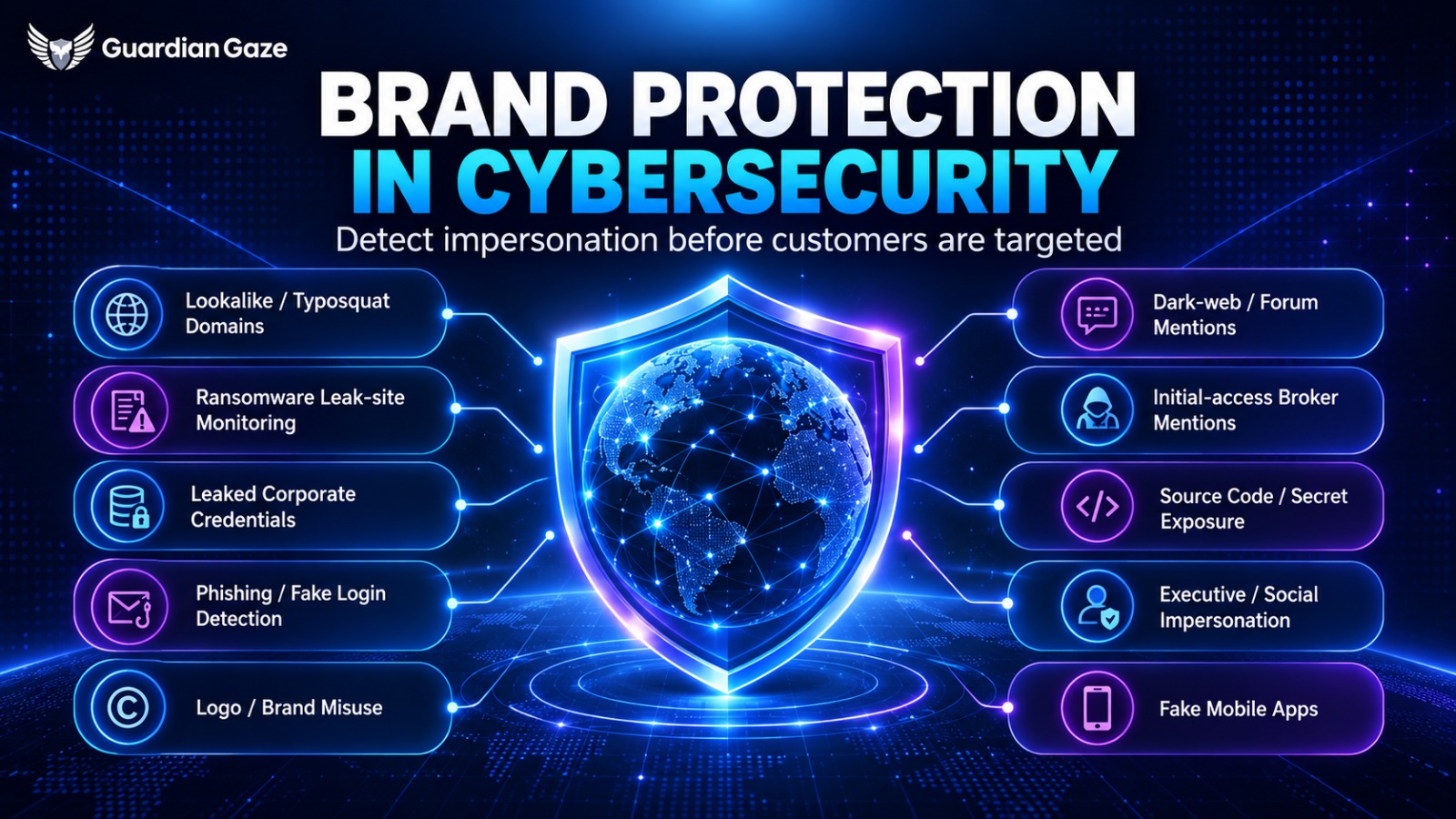
Modern brand protection in cybersecurity is about moving detection further left. Instead of waiting for the victim report, security teams watch for the external signals that commonly appear while an impersonation campaign is being prepared: a new lookalike domain, mail records on that domain, a certificate, cloned page content, leaked corporate credentials, an executive profile that does not belong to the executive, a fake mobile application, or threat-actor discussion that names the company.
The scale of the problem is not theoretical. FTC data for 2025 recorded $3.5 billion in reported losses to imposter scams, including nearly $1 billion attributed to business impersonators. The Anti-Phishing Working Group counted 425,808 phishing attacks in June 2026 alone, its highest monthly total since April 2023. Those figures cover different populations and reporting methods, but they point in the same direction: impersonation remains a high-volume, financially consequential attack pattern.
| Quick Answer Brand protection in cybersecurity is the continuous discovery, verification and response process around external abuse of an organisation’s identity. In practice, that can include lookalike domains, phishing pages, leaked credentials, executive impersonation, malicious brand use, underground mentions, exposed secrets and other signals that suggest somebody is preparing to trade on the trust attached to the brand. |
Brand Abuse Starts Before the Message Lands
A convincing phishing campaign is rarely created in one step. Attackers need somewhere to send the victim, an identity to imitate, and a way to make the request look routine enough to survive the first glance. The exact sequence varies, but the preparation leaves traces.
| Stage | What defenders may observe |
|---|---|
| 1. Prepare | A lookalike domain is registered. A certificate may be issued. DNS and mail records appear. A social account, app listing or fake support identity is created. |
| 2. Copy trust | The attacker borrows the organisation’s visual language: logo, colours, login layout, executive identity, support wording, invoice template or recruitment process. |
| 3. Weaponise | The infrastructure becomes useful: a credential form goes live, a mailbox starts sending, a malicious advert is purchased, a fake installer is uploaded, or a profile begins contacting customers and staff. |
| 4. Scale | The campaign spreads through email, SMS, social media, search ads, messaging platforms or compromised accounts. Redirects and rotating infrastructure can make the same operation harder to block with a single indicator. |
| 5. Monetise or gain access | The objective may be credentials, payment diversion, malware delivery, account takeover, data theft, extortion or simply an initial foothold that can be sold to another actor. |
This is why the earliest useful brand-protection alert is often not “phishing confirmed”. It is a cluster of weak signals becoming strong together. A newly registered brand-like domain is interesting. The same domain with MX records, a freshly issued certificate and a copied login page is a very different event.
The Signals That Matter Most In Modern Brand Protection
A mature programme has to look beyond one channel. Attackers move between domains, credentials, social identities, code-sharing platforms, app stores and underground communities because each surface gives them a different route to trust or access. The practical goal is to collect enough context to decide which observation deserves action now and which one simply needs watching.
Lookalike and Typosquat Domains
Character substitutions, missing letters, added words, hyphens, alternate TLDs and Unicode homographs can all produce a domain that looks credible in an inbox or on a phone. Brand plus a plausible modifier such as “secure”, “support”, “login”, “pay”, “careers” or a regional term can be more convincing than an obvious typo.
Phishing and Fake Login Infrastructure
A live page that imitates a real authentication, payment or support journey moves the risk from suspicious registration to active abuse. Useful evidence includes page content, forms, redirect behaviour, hosting, certificates, mail configuration and the destination of submitted data where it can be observed safely.
Leaked Corporate Credentials
Corporate email addresses and credential material appearing in breach or combo data can be an early identity-risk signal. Freshness, attribution and context matter because recirculated historic data should not receive the same urgency as a recent exposure tied to an active account.
Ransomware Leak-site and Extortion Monitoring
A company name appearing on a ransomware or extortion leak site is an immediate escalation signal. It should be correlated with internal incident handling and other external evidence rather than treated as a conventional brand mention.
Dark-web, Forum and Initial-Access-Broker Mentions
Threat actors may advertise access, credentials, databases or infrastructure before the organisation sees an obvious external incident. Mentions need verification and context, but they can materially change the priority of otherwise ambiguous indicators.
Source-code and Secret Exposure
API keys, tokens, private keys and other secrets can escape through public repositories, forks, issues, snippets and developer workflows. GitHub’s 2026 expansion of public secret monitoring reflects the operational reality that secrets can leak outside repositories formally owned by the enterprise.
Executive and Social Impersonation
A believable account using an executive’s name and photo can support payment fraud, recruitment scams, fake support, investment scams or spear-phishing. The dangerous profiles are not always exact copies; subtle variations are often enough when the victim sees the message out of context.
Logo and Brand Misuse
Copied logos, favicons, product screenshots and visual assets help connect otherwise unrelated infrastructure to a campaign. Visual similarity is most valuable when it is combined with domain, hosting, account-age and behavioural evidence.
Fake Mobile Applications
Rogue or misleading apps can exploit a brand’s reputation for credential theft, payment fraud, ad abuse or malicious software delivery. Monitoring should include publisher identity and listing behaviour, not just a string match on the app name.
Why Lookalike Domains are Still One of the Hardest Problems
The obvious defensive idea is to register every confusing variation first. In practice, the namespace is too large. There are spelling variations, homoglyphs, added words, country and generic TLDs, hyphenation, prefixes, suffixes and subdomain tricks. Buying a handful of high-risk defensive domains can still be useful, but it does not replace monitoring.
The problem is made harder by context. A user reading on a mobile device may see only the first part of an address. A sender can place the trusted word before the real registrable domain. A compromised legitimate website can host a phishing path without any new domain registration at all. Microsoft’s 2026 phishing research has documented both brand-impersonating domains and domain-shadowing techniques, while a September campaign used large sets of brand lookalikes to distribute counterfeit software installers.
That makes correlation more useful than a simple similarity score. A brand-like registration becomes more interesting when it also has mail infrastructure, a certificate, hosting, cloned content or a relationship to infrastructure already associated with abuse. The job of the detection layer is to narrow the universe. The job of verification is to decide what the evidence actually means.
| Practitioner lesson Teams dealing with impersonation repeatedly run into the same operational problem: discovering a suspicious domain is easier than deciding whether it is truly malicious, identifying the responsible provider, building a convincing evidence package and following the case through. The programme has to be designed around that workflow, not just around generating more alerts. |
Brand Protection is an Identity Problem as Much as a Domain Problem
A domain can imitate the company. A stolen credential can impersonate a person from inside the real company. That distinction matters because the second case often looks more trustworthy to the recipient. Microsoft has documented recent executive and invoice-fraud activity that used lookalike domains and fabricated communications, while Mandiant reported that compromised legitimate credentials were used for initial access in 21% of the 2025 ransomware intrusions where the initial vector was identified.
For defenders, leaked-credential monitoring becomes more valuable when it feeds a response path. A fresh exposure tied to a live corporate identity should prompt credential rotation or reset, session review where appropriate, checks for password reuse and a look at the surrounding source of exposure. A cluster of addresses from the same organisation can be more meaningful than a single old record that has been circulating for years.
The same principle applies to exposed secrets. A token in a public repository is not primarily a reputation issue; it is an access issue. The immediate security value comes from identifying the secret, revoking or rotating it, checking for use, and then understanding how it became public. That is why brand protection and external attack-surface intelligence increasingly overlap with identity and developer-security workflows.
The Real Challenge is Triage, Not Collection
The internet will always produce false friends: domains that resemble the brand by coincidence, authorised resellers, regional partners, old defensive registrations, fan accounts, news references, stale breach records and legitimate developers using the same words in code. If every match becomes an urgent incident, the programme trains its own analysts to ignore it.
High-quality triage asks better questions:
- How close is the name or visual identity to the real brand, and is the similarity likely to confuse a customer or employee?
- Was the asset created recently, and did other preparation signals appear soon afterwards?
- Does the domain have MX records, a certificate, active content or redirect behaviour?
- Is the site or account copying a specific customer journey, executive identity, recruitment flow or payment process?
- Is there related credential exposure, source-code leakage, underground discussion or other threat intelligence that changes the context?
- Is there evidence of active targeting, or is the indicator still in a preparation stage where early action may be simpler?
- Who owns the response: SOC, fraud, legal, brand, identity, infrastructure, communications, or a combination of them?
This is where analyst verification earns its place. Automation is excellent at generating candidate lookalikes and correlating technical signals. Human review is valuable when an action carries external consequences, especially takedown, legal escalation or customer communication.
A Practical Response Playbook for Brand Impersonation
The fastest teams do not invent the process during the incident. They decide in advance what evidence to preserve, who owns containment, which providers and platforms receive reports, and what threshold triggers customer or partner communication.
Confirm and Classify the Finding
Decide whether this is suspicious infrastructure, active phishing, credential exposure, an executive impersonation, exposed code or secrets, an extortion signal, or another category. The classification determines the next action.
Preserve Evidence
Capture URLs, screenshots, timestamps, DNS, certificate details, registration information, hosting, account identifiers and any message samples. Evidence can disappear quickly once infrastructure rotates or a platform acts.
Reduce Immediate Exposure
Block confirmed malicious domains and URLs in the controls you manage. For leaked credentials or secrets, rotate or revoke the affected material and review relevant sessions or authentication activity.
Build the External Action Path
Identify the registrar, host, platform, app store or service provider with authority to act. Submit a focused evidence package using the provider’s abuse process rather than a generic complaint with no technical context.
Escalate According to Impact
If the campaign is active, bring in fraud, legal, communications, identity or incident-response teams as appropriate. A ransomware leak-site claim or a credible initial-access-broker listing deserves a different escalation path from a parked lookalike domain.
Track Until the Risk Changes
Do not treat the submission email as the end of the case. Record status, follow up, re-check the asset and watch for replacement infrastructure or accounts.
Feed the Lesson Back Into Monitoring
Add confirmed patterns, brand terms, executive names, campaign language, hosting relationships and high-risk channels to the monitoring model so the next iteration is easier to identify.
Takedown Works Best As An Evidence Workflow
Takedown is often discussed as though it were a single button. The practical work is evidence, routing and persistence. Registrars, hosts, social networks and app stores have different abuse policies, different evidence expectations and different response times. A well-constructed case makes it easier for the party with authority to understand why the asset is abusive and what action is being requested.
GuardianGaze’s public takedown workflow is built around four stages: detect, verify, file and track. Lookalike candidates are reviewed with registration, hosting, certificate, content and mail evidence before a takedown request is raised, and the case remains tracked through its lifecycle. That is the useful operational distinction between seeing an indicator and managing a response.
How GuardianGaze Enterprise Brings the Signals Together
GuardianGaze Enterprise treats brand protection as part of the organisation’s wider external risk picture rather than as a separate marketing-monitoring feed. The platform brings brand and domain abuse alongside application, network, domain and email, cloud and compliance signals, with findings tied to evidence and prioritised for review.
Within the Enterprise brand-protection capability set, monitoring can surface:
- lookalike and typosquat domains;
- ransomware leak-site references;
- leaked corporate credentials;
- phishing and fake login infrastructure;
- logo and brand misuse;
- dark-web and forum mentions;
- initial-access-broker mentions;
- source-code and secret exposure;
- executive and social impersonation; and
- fake mobile applications.
The value is in the relationship between those signals. A suspicious domain on its own may need review. The same domain appearing alongside phishing content, mail configuration, exposed credentials or other threat intelligence creates a stronger case for prioritisation. That context helps security teams spend time on the findings most likely to require action instead of treating every brand match as equal.
For confirmed impersonation and phishing assets, GuardianGaze can package the evidence and track the takedown workflow through the relevant registrar or hosting channel. For other findings, the platform provides the evidence and context needed to route the issue to the appropriate security, identity, fraud or response process.
| A useful operating principle Do not ask whether a monitoring feed found “a mention”. Ask whether the evidence changes what somebody should do next. Good brand protection turns external observations into prioritised security work. |
What a Strong Brand-Protection Programme Looks Like in Practice
The technology matters, but the operating model decides whether the signal becomes useful. A practical programme should be able to answer the following questions without opening six different spreadsheets or inventing a process during an incident.
- Which brand names, products, domains, executives and customer journeys matter enough to monitor?
- Which channels create the most realistic impersonation risk for this organisation: email, social, recruitment, payments, mobile apps, support or something else?
- Which signals should page the SOC immediately, and which can wait for analyst review?
- How are leaked credentials, tokens and other identity-related findings routed to the people who can rotate or revoke them?
- Who is authorised to approve an external takedown or platform complaint?
- What evidence package is required before a registrar, host or platform is contacted?
- How are repeat campaigns linked so that new infrastructure is recognised as part of an existing pattern?
- How are customers, partners or staff warned when a live campaign creates a realistic risk of confusion?
- How is closure verified, and how long is the environment watched for re-registration or replacement infrastructure?
That last point matters. Attackers can replace a domain, account or page quickly. The measure of a programme is not how many alerts it produced, but how well it reduced the time between preparation, detection, verification and response.
Frequently Asked Questions
What is brand protection in cybersecurity?
Brand protection in cybersecurity is the continuous monitoring, verification and response process for external abuse of an organisation’s identity. It can include lookalike domains, phishing pages, leaked credentials, executive impersonation, malicious brand use, underground mentions, exposed secrets and other evidence that somebody may be trying to exploit the trust attached to the brand.
How can you detect a phishing domain before customers report it?
Lookalike-domain monitoring can identify suspicious registrations, while DNS, mail records, certificate issuance, hosting and page content add context. The strongest early-warning process correlates several of these signals rather than relying on one similarity match.
Does DMARC stop lookalike-domain phishing?
DMARC is important for protecting authorised use of your own email domains. A lookalike domain is a different domain, so it can publish its own mail-authentication records. That is why domain and brand impersonation monitoring is used alongside email-authentication controls.
What should happen when leaked corporate credentials are found?
The finding should be validated and dated, then routed to the identity-response process. Common actions include a password reset or credential rotation, session review where appropriate, checks for reuse and investigation of the likely source of exposure.
What makes a suspicious lookalike domain higher priority?
Priority rises when additional preparation or abuse signals appear, such as MX records, a certificate, active hosting, cloned brand content, a fake login form, redirects, campaign messages or related threat intelligence.
How does domain takedown work?
The usual workflow is to verify the abusive asset, preserve evidence, identify the provider with authority to act, submit the case through the appropriate abuse channel and track the case until the status changes. Evidence quality and provider processes influence how the case progresses.
Why monitor ransomware leak sites and initial-access-broker mentions as part of brand protection?
Because a public claim involving the company name can be an externally observable signal of a much larger security issue. Correlating those references with credentials, domains, external exposure and internal incident data helps the response team decide what requires immediate investigation.
How does GuardianGaze Enterprise support brand protection?
GuardianGaze Enterprise combines lookalike-domain monitoring, phishing and impersonation signals, leaked credentials, dark-web and forum intelligence, ransomware and initial-access-broker references, source-code or secret exposure, executive/social impersonation and fake-app monitoring within the broader external-risk platform. Findings are evidence-led and can be routed into the appropriate response or takedown workflow.
The Goal Is To See the Campaign While it is Still Becoming One
Brand protection is most useful when it shortens the gap between attacker preparation and defender awareness. A fake login page reported by a customer is valuable intelligence, but it is late intelligence. A lookalike domain, a certificate, a fresh credential exposure, a suspicious executive profile or an underground access claim can give the security team an earlier place to start.
The strongest programmes connect those observations instead of treating them as separate feeds. They verify before escalating, preserve evidence, route each finding to the team that can act, and keep watching after the first piece of infrastructure disappears.
That is the practical role of modern brand protection: make the organisation harder to impersonate successfully by seeing the signals earlier, understanding them in context and moving from detection to response with less delay.
| See what is already visible around your brand GuardianGaze Enterprise assesses your external security posture and brand exposure from the outside in, with evidence behind the findings and a clear path into investigation or takedown where appropriate. Request a free rating → |