
Security teams rarely lose sleep over the server that is already in the vulnerability scanner. The awkward one is the staging host, old subsidiary domain or cloud service nobody remembered to put there.
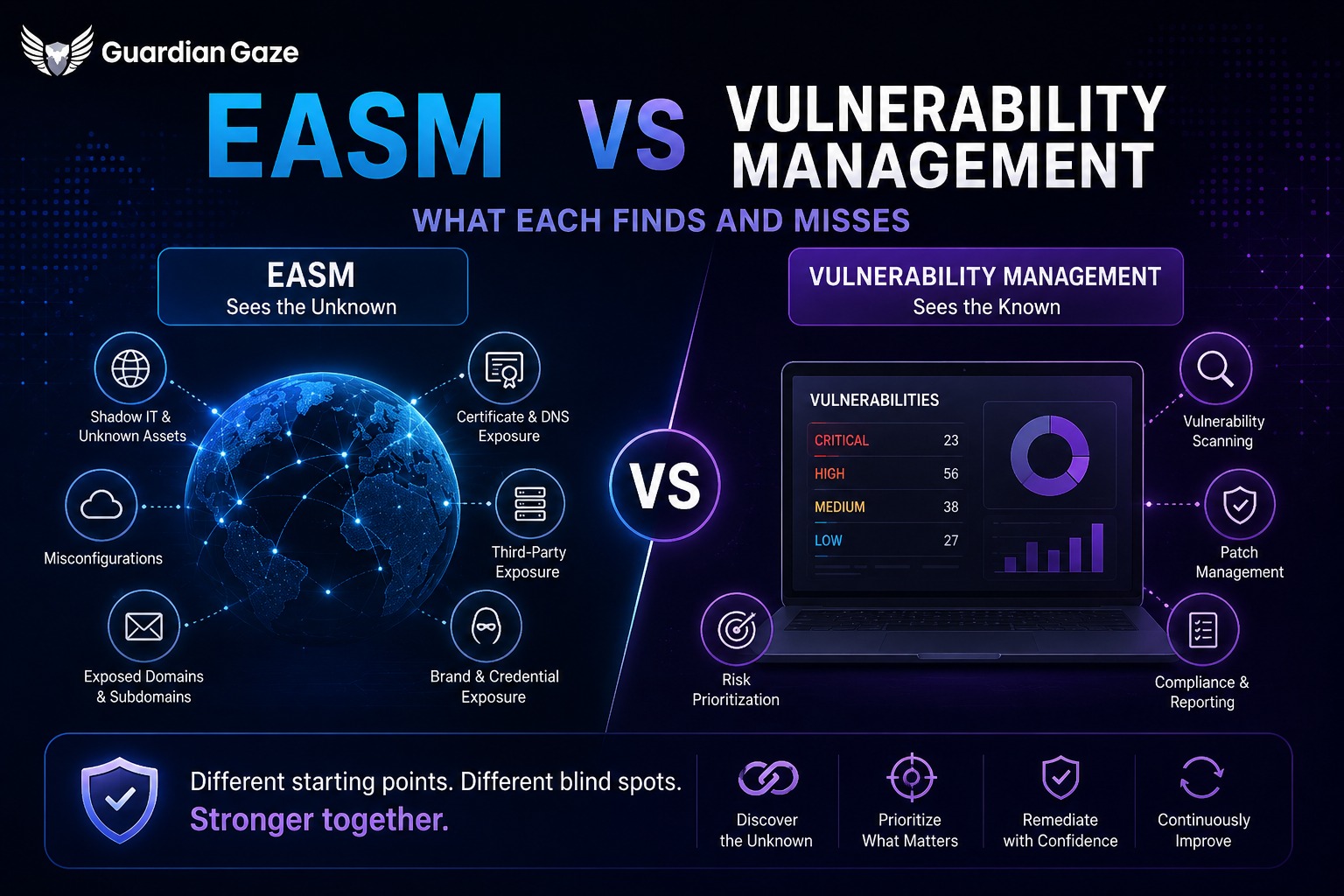
That is the practical difference in EASM vs vulnerability management. Vulnerability management is strongest when a team already knows which systems, applications, addresses or cloud workloads need assessment. External attack surface management, or EASM, starts one question earlier: what does the organisation expose to the public internet, including assets that may never have made it into the expected inventory?
The two disciplines overlap, but they challenge different assumptions. Vulnerability management goes deep. EASM asks whether the external scope was complete in the first place.
Quick answer: Vulnerability management finds and prioritises weaknesses in assets that have been brought into scope. EASM continuously discovers and monitors the external footprint from an attacker’s perspective, including internet-facing assets that may be unknown, forgotten or unmanaged. EASM does not replace authenticated vulnerability scanning, and vulnerability management does not remove the need to validate that your external asset inventory is complete.
At a glance: how the two approaches differ
| Question | Vulnerability management | External attack surface management |
| Where does it start? | Known assets, IP ranges, applications, agents, cloud accounts or other defined scope | External discovery, usually beginning with domains, DNS, certificates, IP relationships and other public evidence |
| Main purpose | Identify, prioritise and drive remediation of vulnerabilities | Discover, attribute and monitor internet-facing assets and exposures |
| Best depth | High, particularly with credentials, agents or platform integrations | External evidence only, without authenticated host visibility |
| Unknown asset discovery | Possible in some platforms, but not the defining workflow | Core workflow |
| Patch and package visibility | Strong with authenticated access or agents | Cannot reliably prove installed patch state from outside |
| External drift | Depends on tooling and scope | Core use case |
| DNS, email and certificate posture | Usually outside the main VM workflow | Common EASM coverage |
| Third-party assessment | Usually requires access or agreed scan scope for deep vulnerability testing | Can observe a supplier’s public footprint without internal credentials |
| Typical blind spot | Assets or exposure that never entered scope | Internal systems, controls and weaknesses that are not externally observable |
The overlap is real. Modern vulnerability management platforms may include network discovery, cloud connectors and asset inventory features. EASM products may also identify externally visible CVEs.
The useful distinction is not that one product can never perform part of the other’s job. It is the security assumption each workflow is designed to challenge.
GuardianGaze’s own external attack surface management capability follows that discovery-first model, but the distinction matters beyond any one platform.
What vulnerability management actually does
Vulnerability management is a programme, not merely a scanner. It combines asset knowledge, vulnerability detection, prioritisation, remediation and verification.
NIST defines vulnerability scanning broadly enough to include identification of hosts, host attributes and associated vulnerabilities. Its technical testing guidance also notes that some vulnerability scanners can perform network discovery and identify ports and services themselves. So it would be inaccurate to say that vulnerability management tools are incapable of finding anything that was not manually entered into a spreadsheet.
Where vulnerability management becomes particularly strong is depth.
An unauthenticated network scan can identify reachable hosts, ports, services and externally observable software characteristics. Credentialed scans can authenticate to systems and inspect installed packages, patch levels and configuration in far greater detail. Agents and cloud integrations can add still more context.
Once an asset is properly under management, a mature vulnerability programme is very good at repeatedly answering questions such as:
- Which known systems have exploitable weaknesses?
- Which packages are missing security updates?
- Which vulnerabilities remain open after remediation?
- Which assets should be patched first?
- Has the fix actually cleared the finding?
The problem appears when the scope itself is incomplete.
A scanner can thoroughly inspect every target it has been given and still say nothing about a forgotten staging host, an old subsidiary domain or a cloud service nobody brought into the vulnerability programme.
The scan is not wrong. It was never looking there.
What EASM changes
External attack surface management treats asset discovery as a continuous security activity rather than a one-off prerequisite.
The public-facing estate changes quietly. Development teams create temporary hosts. Marketing launches campaign sites. Companies acquire subsidiaries. DNS records point to new services. Cloud resources appear and disappear. An old environment can remain reachable long after the person who created it has left.
EASM tries to reconstruct that footprint from outside the organisation, then keep watching it.
A typical discovery process can combine signals such as:
- DNS records and subdomain relationships
- Certificate Transparency data
- IP ranges and historical network relationships
- Registration and ownership information
- Exposed services and technology fingerprints
- Cloud and hosting indicators
- Web content and other attribution evidence
The important word is attribution.
Finding a host on the internet is easy compared with proving that it belongs to a particular organisation.
An IP address in AWS, Azure, Cloudflare or another shared platform does not by itself prove ownership. CDNs, reverse proxies, managed hosting and multi-tenant cloud infrastructure make simple IP-to-company assumptions unreliable.
Strong EASM therefore correlates several signals and should retain enough evidence for the attribution to be questioned.
That is also why external discovery should not be treated as a magic inventory oracle. It is a continuously improved view of what can be attributed from the public side.
GuardianGaze takes the same evidence-first approach across its six Enterprise risk modules, where findings remain traceable to the observation that produced them.
Certificate Transparency is useful, but it is not a complete subdomain inventory
Certificate Transparency is one of the best-known EASM discovery sources, and one of the easiest to oversell.
Chrome requires publicly trusted TLS certificates to satisfy its Certificate Transparency policy. CT provides public, append-only records that allow certificate issuance to be audited. If a certificate explicitly names staging.example.com, that hostname can become a valuable discovery clue.
But CT does not reveal every subdomain an organisation has ever used.
A wildcard certificate such as *.example.com can cover multiple hostnames without each hostname appearing individually in the certificate. Google specifically notes that wildcard certificates can limit how much domain information is disclosed.
Private or locally trusted certificate authorities also sit outside the normal public CT model. Google states that Certificate Transparency applies to publicly trusted CAs rather than manually installed private trust roots.
So a serious EASM workflow does not stop at CT.
Certificate evidence is combined with DNS enumeration, passive observations, network evidence and attribution logic.
That distinction matters because the goal is not to produce the longest possible list of hostnames. It is to identify live, attributable exposure with enough evidence that a security team can act on it.
Where incomplete scope creates real blind spots
The gap between inventory and reality tends to appear in ordinary operational work rather than exotic attack scenarios.
Forgotten development and staging systems
A team creates staging.example.com during a project.
The application is never formally handed over to infrastructure. The project ends, but the DNS record and host remain live.
If it never enters the vulnerability scanner’s scope, routine scanning can remain clean while the forgotten application ages in public.
Assets inherited through acquisition
An acquired business may bring its own domains, web applications, VPN appliances, mail infrastructure and cloud services.
Some are integrated quickly. Others stay where they were.
External discovery can help validate whether the post-acquisition inventory matches what the internet still exposes.
Shadow and temporary cloud infrastructure
Cloud services are easy to create and easy to forget.
A test environment may exist for a few days, while a hostname, storage endpoint or exposed service lasts much longer.
Traditional vulnerability management can assess those systems very effectively once connected or scoped. EASM helps answer whether they were known in the first place.
External configuration risk that is not a CVE
Not every internet-facing weakness has a CVE.
SPF, DKIM and DMARC gaps, weak certificate hygiene, exposed administrative interfaces, risky DNS records and certain cloud exposure patterns may matter without fitting neatly into a software vulnerability queue.
These are external posture questions, which is why they commonly sit closer to attack surface management than patch management.
Brand and credential exposure
One qualification matters here: lookalike domains, leaked corporate credentials and impersonation monitoring are not universal definitions of EASM.
Broader outside-in platforms can extend beyond infrastructure discovery into brand and people-related risk.
GuardianGaze Enterprise, for example, combines attack surface discovery with domain and email security, brand protection, credential exposure, application security, network security, cloud security and compliance mapping. That is product scope, not a reason to stretch the definition of the whole EASM category.
Prioritisation: CVSS, EPSS and KEV answer different questions
Finding an externally exposed vulnerability is only the beginning. A list of CVEs is not a remediation strategy.
CVSS tells you about severity
CVSS is maintained by FIRST and provides a standard framework for communicating vulnerability severity.
With CVSS 4.0, precision matters.
The CVSS Base metrics describe intrinsic characteristics of the vulnerability. FIRST explicitly warns that a CVSS Base score measures severity, not risk.
CVSS 4.0 also includes Threat and Environmental metric groups. These allow consumers to add context such as exploit maturity, local mitigations and the importance of the affected system.
So the commonly repeated statement that “CVSS never changes” is too broad.
A published Base assessment may remain constant, while richer use of CVSS can incorporate threat and environmental context that changes the resulting assessment.
EPSS estimates exploitation probability
FIRST’s Exploit Prediction Scoring System estimates the probability that a published CVE will be exploited in the wild during the next 30 days.
EPSS publishes updated probability scores daily, which makes it useful for separating vulnerabilities that look severe in principle from vulnerabilities for which exploitation is statistically more likely.
It is still a predictive signal. A high EPSS score does not prove that your organisation is being attacked.
CISA KEV tells you exploitation is already known
CISA’s Known Exploited Vulnerabilities Catalog contains vulnerabilities known to have been exploited in the wild and is intended to be used as an input to vulnerability-management prioritisation.
For US Federal Civilian Executive Branch agencies, Binding Operational Directive 22-01 creates remediation requirements. CISA also strongly urges organisations outside the federal government to prioritise timely remediation of KEV-listed vulnerabilities.
KEV is therefore a high-value urgency signal, but even KEV sits inside an operational context. Internet exposure, asset importance, compensating controls and the availability of a safe fix can still affect the response.
Why one score should not make the whole decision
Consider two findings.
The first is a critical CVSS Base vulnerability on an isolated, lower-value system with no known exploitation and very low EPSS.
The second is a lower-severity vulnerability on an internet-facing authentication service that appears in KEV and carries strong exploitation signals.
The second may deserve the earlier response.
But that does not mean every non-KEV critical vulnerability can wait.
A remotely exploitable flaw on a crown-jewel system can warrant immediate action before widespread exploitation appears in public telemetry.
Good prioritisation combines severity, exploitation evidence, exposure and asset context instead of asking one score to carry all four.
GuardianGaze documents the same principle in its security-rating methodology, where findings are weighted by severity and exploitability rather than raw vulnerability counts.
What EASM cannot see
This is where EASM marketing often becomes less useful than EASM engineering.
An external assessment cannot reliably tell you:
- Whether an operating system is fully patched when installed package state is not externally visible
- Whether internal network segmentation is sound
- Whether privileged access is governed correctly
- Whether backups are tested and restorable
- Whether security training is effective
- Whether an incident response process works
- Whether an application has an authorisation or business-logic flaw hidden behind authentication
- Whether a public technology fingerprint reflects the exact installed package state
External fingerprinting itself can be uncertain.
A server may suppress version information, sit behind a reverse proxy, expose a misleading banner or run a vendor-patched package whose visible version resembles a vulnerable upstream release.
That is why an EASM finding should distinguish observation from inference.
A good outside-in platform shows what it saw, how it attributed the asset, why the evidence matters and where confidence is limited. It should not turn an inferred software version into a claim of confirmed compromise.
GuardianGaze’s current Enterprise modules make the same boundary explicit. Internal segmentation, backup testing, privileged-access governance, incident-response procedure and other controls that cannot be seen from outside remain outside the rating’s scope.
That limitation is not a flaw to hide. It tells the buyer which evidence still needs to come from an audit, questionnaire, internal assessment or penetration test.
Why asset inventory still matters before vulnerability remediation
CISA’s Cybersecurity Performance Goals place asset inventory close to the foundation of the problem.
Its guidance specifically calls for better identification of known, unknown, shadow and unmanaged assets so organisations can more rapidly detect and respond to vulnerabilities.
This is the practical relationship between EASM and vulnerability management.
You cannot patch an asset you do not know exists, but discovering an asset does not tell you everything that needs patching.
EASM improves the completeness and freshness of the external inventory. Vulnerability management supplies the deeper assessment and remediation discipline once an asset is under management.
A realistic example: the staging host nobody owns anymore
Imagine a marketing team launched a temporary campaign three years ago.
The campaign used preview.example.com.
The agency that built it no longer works with the company. Nobody deliberately kept the host, but the DNS record still resolves and the old CMS still answers on the public internet.
The vulnerability team scans its approved production ranges every week. Those scans can be perfectly valid while saying nothing about preview.example.com, because nobody added it to the managed scope.
An external discovery process identifies the hostname, confirms that it is live, correlates it with the company’s domain and observes the exposed service.
The finding then goes through attribution and validation before being handed to whoever owns vulnerability remediation. From there, there are two sensible paths.
If the system is no longer needed, remove the exposure. If it is legitimate, bring it into the authoritative inventory and perform the deeper authenticated assessment that EASM cannot provide.
That handoff is the point. Discovery without remediation produces a better list; remediation without discovery can produce a perfectly maintained incomplete list.
The strongest workflow uses both
For a mature security programme, the better model is a loop:
- Discover the external estate continuously.
- Validate ownership and remove false attribution.
- Identify high-signal external exposures.
- Add legitimate assets to the authoritative inventory and vulnerability programme.
- Run deeper credentialed or agent-based assessment where appropriate.
- Prioritise remediation using severity, exploitability, exposure and asset criticality.
- Verify fixes internally and re-observe the public surface.
- Watch for new or changed exposure.
The same model is useful outside your own company.
A supplier is unlikely to give your organisation vulnerability-scanner credentials. An acquisition target may not provide internal access before diligence. A prospective vendor may still be working through security questionnaires.
Outside-in assessment can give you an initial view without pretending it replaces evidence about internal controls.
That is how continuous third-party risk ratings are most useful: as triage and change detection.
If a supplier’s external posture materially worsens, investigate.
If the supplier handles critical data or supports an important business service, supplement the external view with questionnaires, audit reports, contractual controls or direct technical assurance.
The rating tells you where to look harder. It does not make the deeper assurance unnecessary.
Where GuardianGaze fits
GuardianGaze Enterprise is built around the outside-in side of this workflow.
Its attack surface management capability discovers and monitors internet-facing assets, then combines that view with application, network, domain, brand, cloud and compliance signals.
Findings retain evidence, while vulnerability prioritisation can incorporate CVSS, EPSS and KEV rather than relying on raw severity alone. The attack surface management capability is designed around that evidence-led external view.
The normal external assessment does not require agent installation or credentials. Deeper connected cloud posture is a separate optional workflow that can use scoped, read-only access when an organisation chooses to connect it.
That boundary is deliberate.
GuardianGaze can help answer: What does the outside world see, what changed, and what should we investigate first?
It cannot prove that an internal segmentation policy works or that every server is patched correctly from the inside.
Those remain jobs for internal security controls, vulnerability management, audits and authorised security testing.
Frequently asked questions
Is EASM a replacement for vulnerability management?
No. EASM is strongest at discovering and continuously monitoring the externally visible estate. Vulnerability management provides greater depth on managed assets, particularly with authenticated scans, agents and internal context.
Most organisations that need EASM still need vulnerability management.
Can vulnerability scanners discover unknown assets?
Some can. NIST notes that certain vulnerability scanners can perform network discovery and service identification. The distinction is that continuous external discovery and attribution are core design goals of EASM, while vulnerability management is primarily concerned with finding, prioritising and remediating weaknesses within managed scope.
Can EASM detect CVEs?
Yes, when enough externally observable evidence exists. The important caveat is confidence: external version fingerprinting can be incomplete or misleading, so a remotely inferred CVE should not automatically be treated as equivalent to an authenticated package check.
What is the difference between EASM and vulnerability scanning?
Vulnerability scanning is one technical activity inside a broader vulnerability management programme.
EASM combines external asset discovery, attribution, exposure assessment and continuous monitoring.
The two overlap on externally visible weaknesses, but they begin with different assumptions.
Does EASM need credentials?
The core external-discovery model typically does not. Some platforms add optional connected capabilities for deeper cloud or internal context, but those should be distinguished from the outside-in EASM layer rather than presented as the same type of assessment.
Where does penetration testing fit?
A penetration test asks another question: it uses scoped, authorised testing to validate exploitability, attack paths and security weaknesses at greater depth.
EASM can help identify where exposure has changed and where deeper testing may be worth prioritising. Vulnerability management supplies the recurring vulnerability-remediation workflow. A penetration test provides manual validation and attack-path depth that neither automated approach fully replaces.
The real blind spot is assuming your list is complete
EASM vs vulnerability management is not a contest between two scanners.
Vulnerability management can go much deeper than an external platform once an asset is known and accessible.
EASM earns its place earlier in the chain by challenging whether the public-facing inventory reflects what is actually exposed.
Neither view is complete on its own. If your vulnerability programme is strong, EASM gives you a way to test the boundary of its scope.
If your EASM programme is strong, vulnerability management gives discovered assets somewhere to go for deeper verification and remediation. The useful question is therefore not: Which one should we buy?
A better question is: Where can an asset disappear between discovery, ownership and remediation? That gap is where the blind spot lives.
See your external attack surface first
The easiest environment in which to judge an outside-in assessment is one you already understand: your own.
GuardianGaze can produce an external security rating without installing an agent or requiring ordinary internal access. An analyst reviews the assessment before the rating is delivered, and the findings provide the evidence behind the result rather than only a headline number.
Request a free security rating and compare what the public internet exposes with the inventory you believe you have.